Dyeing/Finishing/Printing —Major growth predicted for DTF and DTG
Resource-efficient and cost-effective systems have a low impact on the environment.

Over 65% of Shein’s directly sourced prints are
now produced using its in-house developed
Digital Thermal Transfer Printing process.
contents
—Introduction: Digital Textile Printing Enters a Rapid Growth Phase
—Core Advantages of Digital Textile Printing
—Key Manufacturers of Digital Textile Printing Machines
—DTF & DTG: Digital Printing Technologies Reshaping the Industry
—DTF Printing: A Major Growth Driver, Powered by China’s Investments
—Shein: An Innovation Pioneer in DTF Printing
—Contact Us for Digital Textile & Garment Printing Solutions
Textiles Intelligence, a global business information company, has released a new report. It reveals that Direct-to-Film (DTF) and Direct-to-Garment (DTG) digital textile printing will grow rapidly in the years ahead.
Digital textile printing offers unlimited color options, customization, and flexibility in design and production. It has also made significant advancements in recent years.
These progressions are driven by better automation, improved ink formulations, and upgraded print head technology.
Today’s digital textile printing machines are highly flexible. They can print on a wide range of fabrics. What’s more, most of these machines do not need pre-processing or post-processing equipment. They also don’t require specialized operators.
As a result, they save resources and reduce costs. Their operation also has a low environmental impact.
Several companies produce digital textile printing machines. Major players include:
- Brother
- EFI Reggiani
- Epson
- Kornit Digital
- Mimaki
- Sawgrass
DTF and DTG printing are having a deep impact on the textile industry.
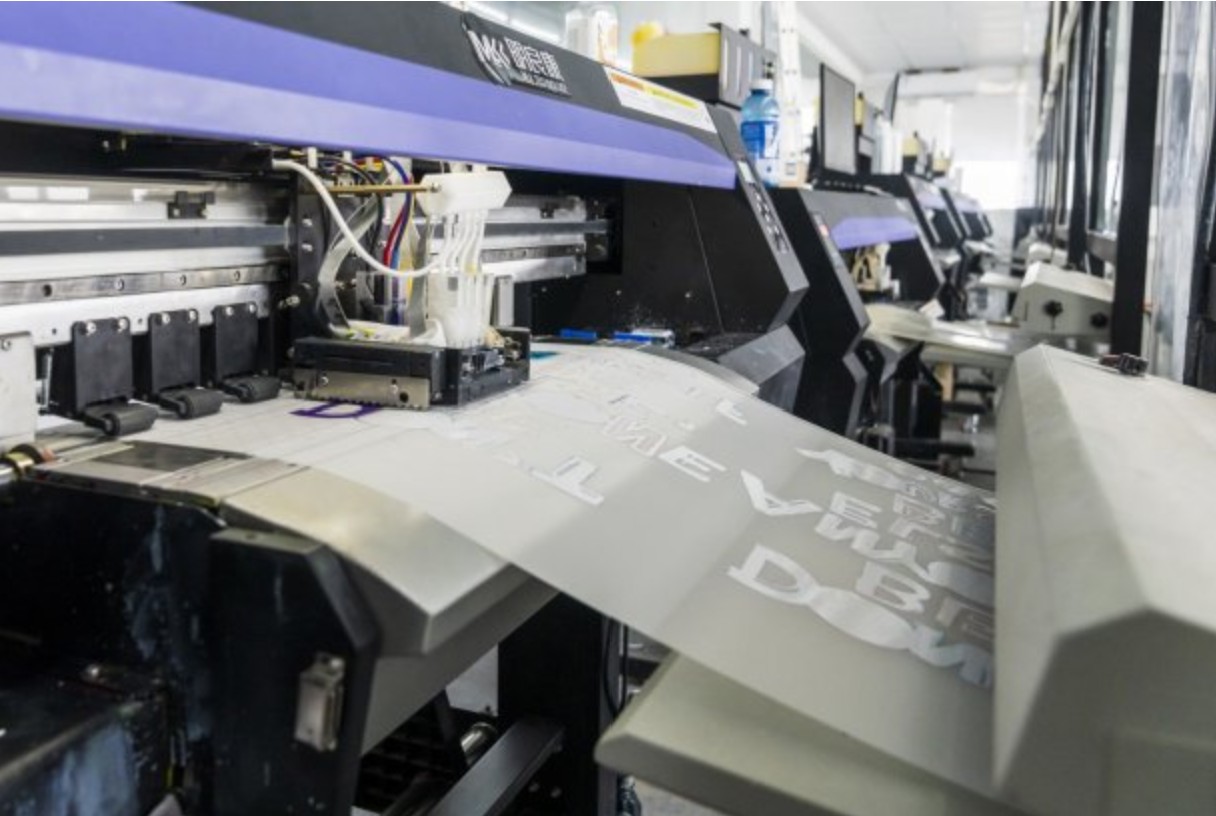
- DTG printing: Uses inkjet technology to print high-quality, full-color designs directly onto garments.
- DTF printing: Relies on a polyester film to create bold, durable designs on fabric.
These relatively new digital printing technologies excel at making on-trend designs. They also support on-demand production. For this reason, designs made with these technologies are perfect for e-commerce platforms—since these platforms thrive on fast turnaround times and diverse product ranges.
They also suit the fast fashion sector. Fast fashion depends on quick design updates and frequent product launches. DTF and DTG printing meet these needs by cutting lead times and streamlining production processes. In fact, these technologies were developed specifically to address the growing demands of e-commerce and fast fashion.
DTF printing has become a standout trend in recent years.
Estimates suggest that around 7 billion items worldwide were produced using DTF printing in 2024. Today, 50% of all T-shirts made globally are decorated with DTF technology.
Most of this growth is driven by large-scale investments in China.
Shein—a Singapore-based online retailer specializing in ultra-fast fashion—is a pioneer in DTF printing.
The company has developed two in-house DTF printing methods:
- Digital Thermal Transfer Printing
- Cool Transfer Denim Printing
Both methods are reported to have low environmental impact. Cool Transfer Denim Printing is particularly notable: it is used to add wash effects to denim, and uses 70% less water than traditional denim washing methods.
If you need any products related to digital printing on fabrics or garments, feel free to contact
TopapparelCN here. We will get back to you as soon as possible!
 Xin Li